
Contact

Insights on how people really choose

Guides and articles on brand, websites and marketing.

Newest

A line chart on a dark blue ground: the share of the US Google searches DataForSEO tracks showing an AI Overview rising from 6% to 61% between September 2024 and August 2026, with four other search features in fainter lines

Report · Search

Google’s AI answers are as common in the UK as in the US

More than half the US Google searches DataForSEO tracks now show an AI Overview, up from one in seventeen in September 2024. Google brought AI Overviews to the UK from August 2024, three months after the US. To see whether the UK is still behind, we checked 1,768 of the most popular UK searches in six sectors on Google UK and Google US on the same day: 90% showed one in the UK and 89% in the US.

11 min read
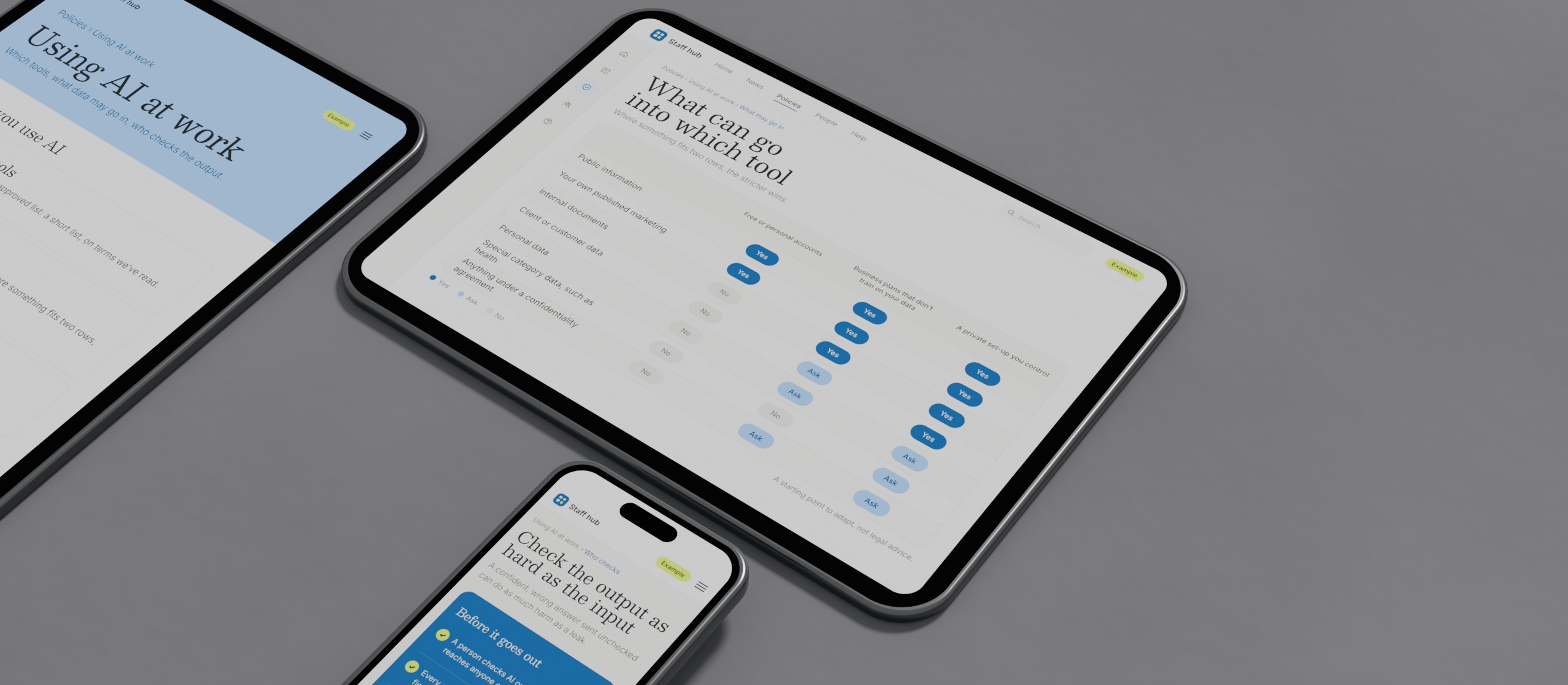
A staff AI policy shown on two tablets and a phone: a page titled Using AI at work, a grid of what can go into which tool, and a page on checking the output

Guide · Strategy

Write your AI policy from what your team already does

In a survey of 2,003 UK employees that Microsoft commissioned in 2025, 71% had used AI tools at work that their employer had not approved. A short policy, built from the habits people already have, replaces those private rules with shared ones.

7 min read

Every guide and article

Filter by topic

Search

Google’s AI answers are as common in the UK as in the US

More than half the US Google searches DataForSEO tracks now show an AI Overview, up from one in seventeen in September 2024. Google brought AI Overviews to the UK from August 2024, three months after the US. To see whether the UK is still behind, we checked 1,768 of the most popular UK searches in six sectors on Google UK and Google US on the same day: 90% showed one in the UK and 89% in the US.Report · 11 min read
Strategy

Write your AI policy from what your team already does

In a survey of 2,003 UK employees that Microsoft commissioned in 2025, 71% had used AI tools at work that their employer had not approved. A short policy, built from the habits people already have, replaces those private rules with shared ones.Guide · 7 min read
Strategy

Where people leave your marketing funnel, and why

The stages of a funnel matter less than the gaps between them. Data shows where people drop out, but only talking to them tells you whether they meant not now or not you.Guide · 7 min read
Marketing

Where AI helps in marketing, and what should stay with people

In the UK government's AI adoption survey 2026, marketing came second only to administration as a use of AI. It can take on the reading, sorting and drafting, but who you are for, what you stand for and what you claim should still be decided by people.Guide · 7 min read
Strategy

How to do a competitor analysis that changes something

Without a decision to inform, a competitor analysis becomes a long spreadsheet and changes nothing. Start from the decision you have to make, include the options your customers weighed, and finish with a short list of what you will do differently.Guide · 7 min read
Strategy

How to build an AI strategy from your own goals

In the UK government's AI adoption survey 2026, 65% of private-sector businesses with five or more employees that were neither using nor planning to use AI cited the lack of a clear business case or proven return on investment. A strategy builds that case from the organisation's own goals, and is as clear about where AI will not be used as where it will.Guide · 6 min read
Strategy

Give AI the dullest job in your week first

Meeting notes, first drafts and summaries are the best places for a business to start with AI: the work is routine, and a person can check the result in minutes. Measure the pilot against how the job went before, then keep it, change it or stop it.Guide · 6 min read
Search

GEO is SEO with three new jobs

The 2026 data shows the old signals, links in particular, still go with being quoted in AI answers. Most businesses need no separate GEO budget; they need their SEO to take on three new jobs.Guide · 4 min read
Human-centred design

Customer journey maps, and what they miss

A good journey map shows where people hesitate on the way to choosing you. One drawn in a workshop, from the inside, can look complete and still miss most of what decides the choice.Guide · 7 min read
Search

What AI search means for growth

A buyer can now get a shortlist from an AI assistant before they visit any website. If you are not in the answer you may never hear about the decision, which makes search a question for the whole business rather than the web team.Guide · 7 min read
Strategy

Marketing to a buying committee

In Gartner's survey of 632 business buyers, published in 2025, buying groups ran from five to 16 people and 74% showed what Gartner calls unhealthy conflict. Keep one story for all of them, change the proof for each, and equip the person who argues your case in rooms you never enter.Guide · 7 min read
Sectors

How healthcare providers win the trust of insurers, solicitors and case managers

When an insurer or a solicitor chooses a provider for someone else, their own name goes on the choice. Two studies with the people who choose found the same thing: they want to find the right person quickly, and to trust them before they pick up the phone.Guide · 7 min read

One piece a month

On brand, websites and how people choose.

Behavioural design

Behavioural design when someone buys for an organisation

A person buying for an organisation puts their own standing on the line as well as the budget, and has to defend the choice to people you never meet. Behavioural design helps by making a sound choice easier to make and easier to argue for.Guide · 7 min read
Behavioural design

Behavioural design when people buy for themselves

When people choose for themselves, the strongest competitor is often their own habit. They decide in a spare moment, usually on a phone, so the new option has to be the easy one.Guide · 7 min read
Strategy

Why “we need more leads” is usually the wrong brief

When a business says it needs more leads, the right people are often already arriving and quietly leaving, or the wrong ones are taking up everyone's time. More volume makes both worse, so find the link in the journey that breaks before paying for more attention.Article · 7 min read
Conversion

Why your homepage headline is costing you enquiries

A Microsoft Research study of 205,873 web pages, published in 2010, found people were most likely to leave in the first few seconds of a visit, which is when they meet the headline. If a competitor could sign yours unchanged, rewrite it.Article · 7 min read
Conversion

Why one clear call to action beats five

Book a call, download the guide, follow us, sign up: a page that asks for all of it tends to get none. Choose the one action that matters most on each page, repeat it as people scroll, and name the button for what they get.Article · 8 min read
Brand

Why a point of view beats being good at everything

Being good at everything for everyone feels safe, and gives nobody a reason to choose you. A stance some people will disagree with does more to win the right clients, and you probably act on one already.Article · 8 min read
Sectors

Who decides when a healthcare provider is chosen

Clinical leads, procurement, finance and risk each protect something different, and any of them can say no. Map who decides, give each the proof they need, and equip the person who argues your case.Article · 7 min read
Marketing

What makes content worth citing

Journalists, peers and AI assistants quote a page when it holds something they cannot easily find elsewhere: a finding, a real example or a sharper explanation. Length and keyword density have little to do with it.Article · 8 min read
Brand

What is brand strategy?

Brand strategy sets out how your organisation wants to be known, by whom, and why they should believe it. The logo comes later, as one way of expressing it.Guide · 10 min read
Brand

What is brand positioning?

Positioning is the place you choose to hold in people's minds: who you are for, and why they should pick you over the other sensible options. Many organisations that think they have one have a description instead.Guide · 10 min read
Strategy

What is a marketing agency, and what does one do?

An agency is an outside team that plans and delivers marketing, from full-service firms to single-discipline specialists. Who will do your work, and how long clients stay, tell you more than the pitch.Guide · 10 min read
Websites

What is a brochure website?

A brochure website is a handful of pages saying who you are, what you offer and how to get in touch. For organisations that win work through referrals and conversations it is often exactly right, until they need search to bring in new enquiries.Guide · 11 min read
Human-centred design

What good discovery looks like

At its worst, discovery is a kick-off meeting and a shared folder. Done well, it finds the thing that changes what you would otherwise have done, usually by talking to people on the other side of the decision.Article · 8 min read
Strategy

What does a marketing consultant do?

You bring a consultant in to make better decisions rather than to do more marketing. They review what is working, learn your market and the people you need to reach, then build a plan and help deliver it.Guide · 10 min read
Brand

What a brand is, beyond the logo

Ask most people what a brand is and they point at the logo. A brand is the set of decisions that make you recognisable and the obvious choice; the logo is where those decisions become visible.Article · 7 min read
Search

What AI search means for your website

More people ask an AI assistant before they search, and it names only a few sources. The pages it draws on answer a real question early, plainly and specifically, the same qualities that made a page worth reading before.Article · 8 min read
Websites

The real cost of a confusing website

Nobody emails to say they got lost on your website. They leave, and the cost shows up later as fewer enquiries, bookings or donations, often blamed on traffic. Most of the fix is taking things away.Article · 8 min read
Human-centred design

The one question that improves any piece of marketing

Before any page, email or post goes out, ask what the person reading it needs to think, feel or do next, and whether you have made that the easiest thing in front of them. Asked honestly, it cuts more than it adds.Article · 7 min read
Behavioural design

Social proof that persuades

A row of logos and a star rating show you are popular, which is rarely what someone deciding wants to know. Proof persuades when it answers a specific fear, from someone like the reader, at the point they hesitate.Article · 8 min read
Sectors

Recruitment marketing in a market of lookalikes

When every recruiter promises people, partnership and results, none of it gives an employer or a candidate a reason to choose. Find the claim that is only true of you by asking the people who chose you, and the ones who didn't.Article · 7 min read
Brand

Rebranding without throwing away what already works

Recognition takes years to build and very little time to lose. Before deciding what to change, ask customers, staff and partners which parts of the old brand still do real work for you.Article · 7 min read
Behavioural design

Marketing to buyers who are trained to doubt you

A finance director, a solicitor or a careful donor has heard every claim before. Say one plain thing you can stand behind, and give them something they can check for themselves.Article · 7 min read
Strategy

Marketing agency or in-house team?

An in-house team knows the organisation and is always there; an agency brings range, senior experience and an outside view. Many organisations end up with both, and neither fixes a strategy nobody has agreed.Guide · 10 min read
Strategy

Making a complex offer simple without dumbing it down

Some offers really are complicated, and the temptation is either to bury people in detail or to retreat into fluff. The work is deciding what each audience needs to understand to take the next step, and saying that in their words.Article · 8 min read
Behavioural design

Loss aversion, used honestly

People feel a loss more sharply than an equal gain. The honest use of that is to show someone a cost they are already paying, such as enquiries leaking away, rather than to invent a deadline.Article · 7 min read
Human-centred design

Jobs to be done, in plain terms

People hire a product or service to make progress on something. Ask buyers what was happening when they started looking and you will find the job, which can differ between buyers who look alike on paper.Article · 8 min read
Websites

How to write a homepage for people who scan

Visitors decide in seconds whether a homepage is worth reading. Write the headline and subheadings so they tell the whole story on their own, and treat the paragraphs as extra.Article · 7 min read
Strategy

How to build a marketing strategy

A marketing strategy is a short set of choices: who to win, what to say, where to show up and how to tell it is working. Fix the message before you spend on channels, and do two or three of them well.Guide · 14 min read
Websites

How much does a website cost in the UK?

Two websites that look alike can cost very different amounts, because the price is set by decisions about content, design, connections and aftercare rather than by the number of pages. Content is the cost people most often underestimate.Guide · 10 min read
Conversion

Designing an enquiry journey people finish

By the time someone goes to get in touch, they have done the hard part. A nine-field form, a vague promise to reply and a calendar before anyone has said hello are how websites lose them.Article · 7 min read
Behavioural design

Defaults decide more than your sales pitch

People accept what is already selected far more often than they choose something else, so the option you make easiest often beats the case you make for another. Your biggest competitor may be the buyer's own default: staying put.Article · 8 min read
Human-centred design

A year of human-centred marketing, in one page

Everything we write comes back to one idea: decide from how people really behave, not how you would like them to. Here it is on one page, from the first research to what happens after launch.Article · 8 min read
Brand

What a brand actually is (and isn’t)

Article
Behavioural Design

Social proof that works (and the kind that doesn’t)

Article

Ways we can help

Positioning and strategy

We start by defining where you compete and testing it against how your buyers really decide.

Branding and identity

We build identities that signal the right level of expertise wherever a buyer forms a view of you.

Digital solutions

We plan every page around the questions buyers arrive with and the doubts that slow them down.

Marketing and visibility

We set the commercial priorities first and build the content and search programme that keeps you visible across a long sales cycle.