
AI consultancy that turns trying AI into using it every week
Ideate Partners helps small and mid-sized organisations turn scattered AI experiments into work that’s done better every week, with rules people trust and results you can measure. AI does the legwork. People make the calls.
When to call us
- 01
Staff use ChatGPT, and nobody set rules
People paste work into free accounts on their own phones. You don’t know what’s gone where, and a ban would only hide it.
- 02
A pilot went nowhere
Licences were bought or a trial was run. The early buzz faded, and six months on nobody can say what changed.
- 03
One enthusiast is carrying it
One person uses AI well and everyone else asks them. When they’re on holiday, it stops.
- 04
The board wants an AI plan
Directors or trustees want something specific and defensible by next quarter, not a slide of logos.
- 05
You don’t know where to start
Every tool promises everything. You want someone to look at your work and say where AI helps first.
What is AI consultancy?
AI consultancy is independent help to decide where artificial intelligence will improve how your organisation works, then to put it in place: the uses worth doing, the rules for safe use, the set-up, the training and the measures that show it’s working. Good AI consultancy ends with your own people running it, not with you relying on the consultant.
How it works, from first look to working habit
Six stages, starting with a readiness review that stands on its own. Each ends in something you keep. You can stop after any stage. Lengths are typical; we confirm yours after the review.
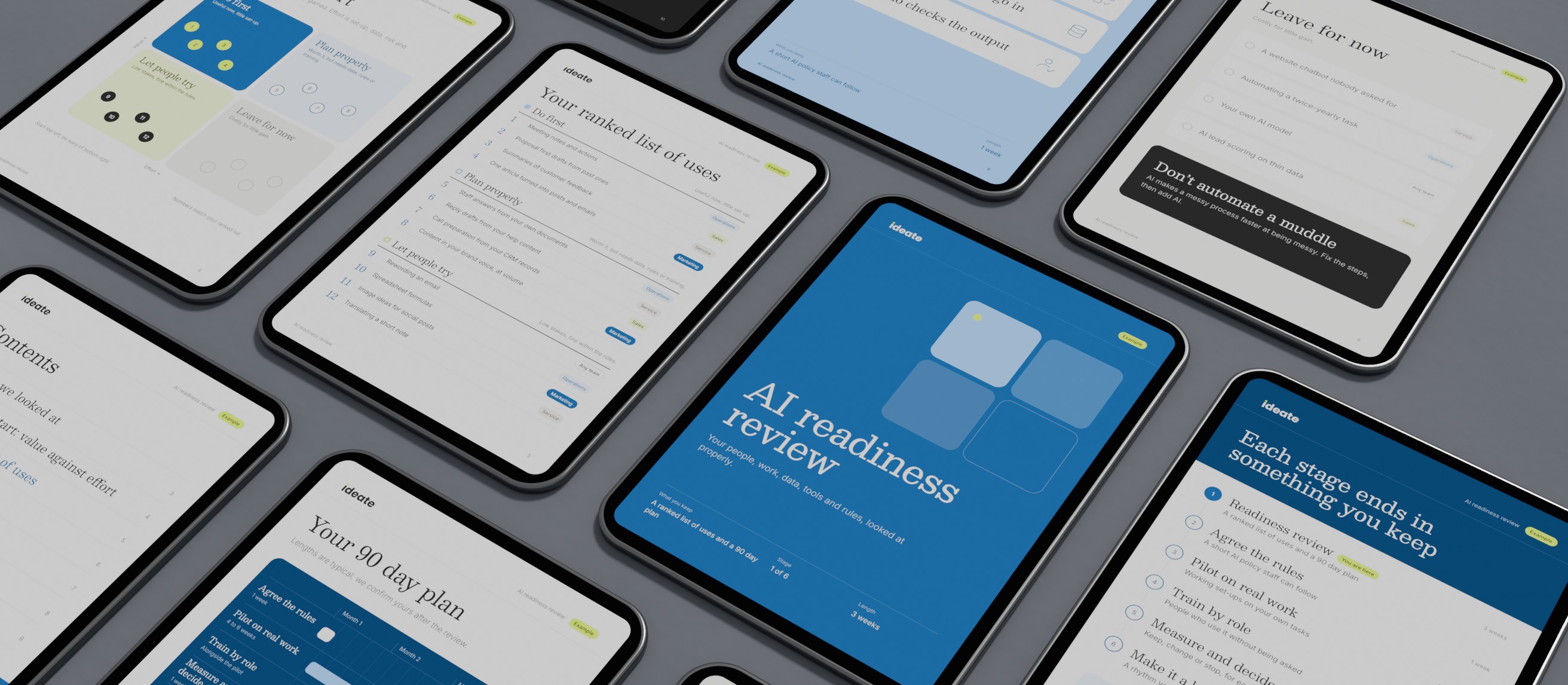


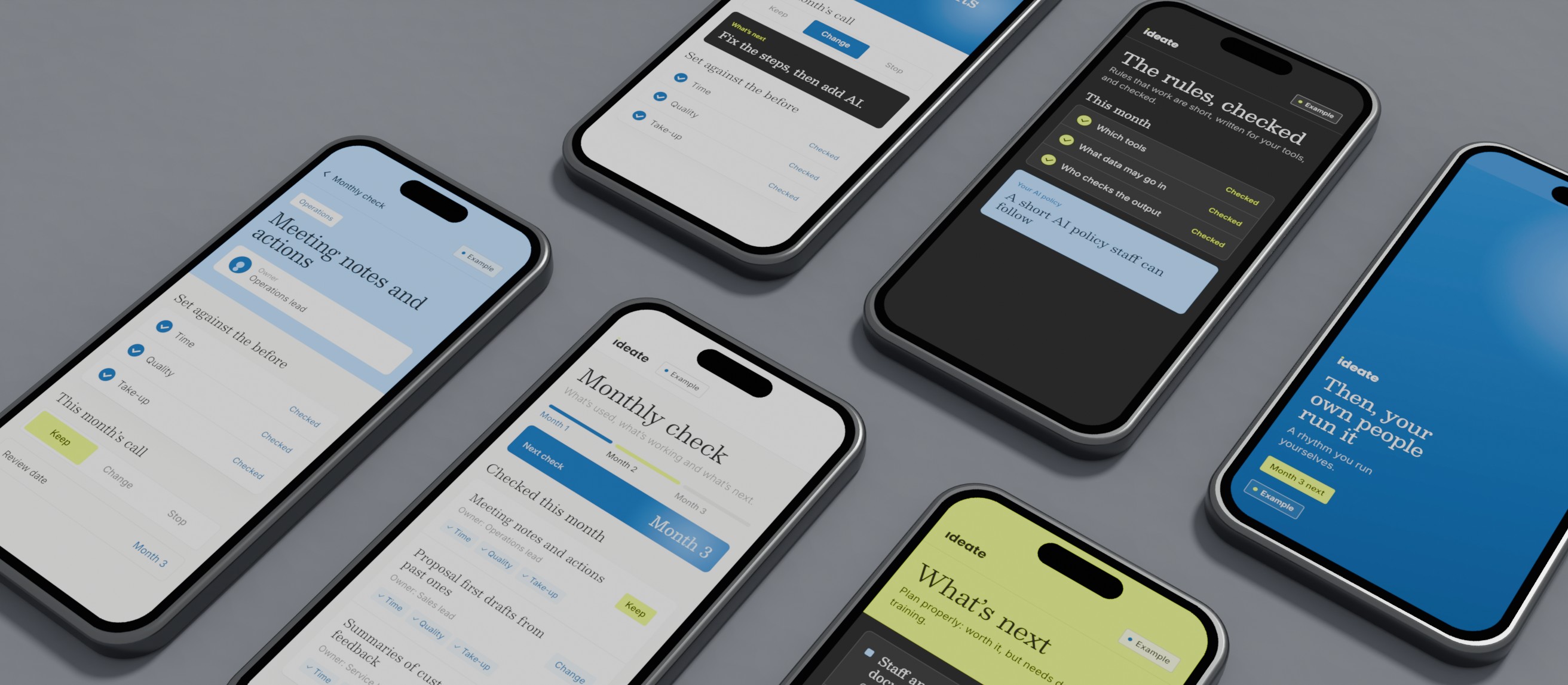
013 weeksReadiness review: Your people, work, data, tools and rules, looked at properly. You keep: A ranked list of uses and a 90 day plan.
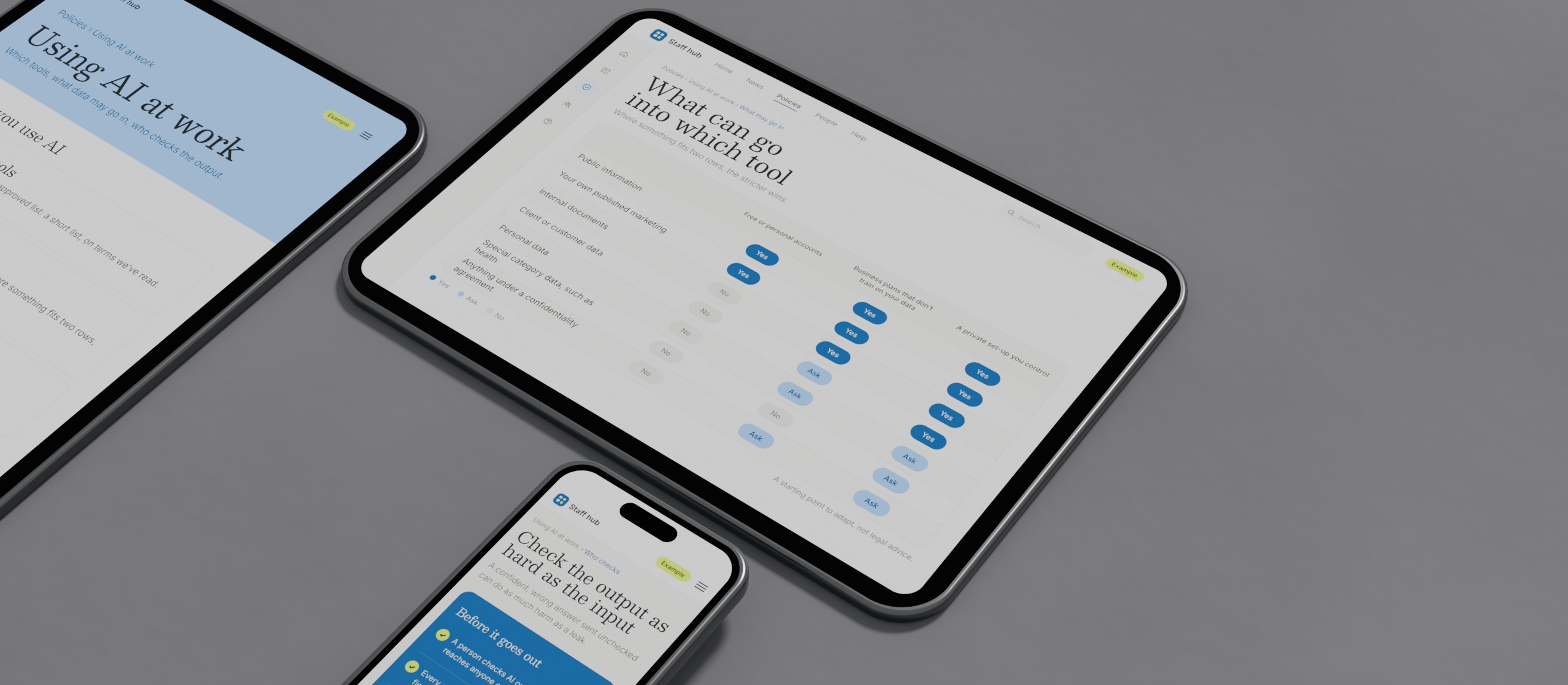
021 weekAgree the rules: Which tools, what data may go in, who checks the output. You keep: A short AI policy staff can follow.
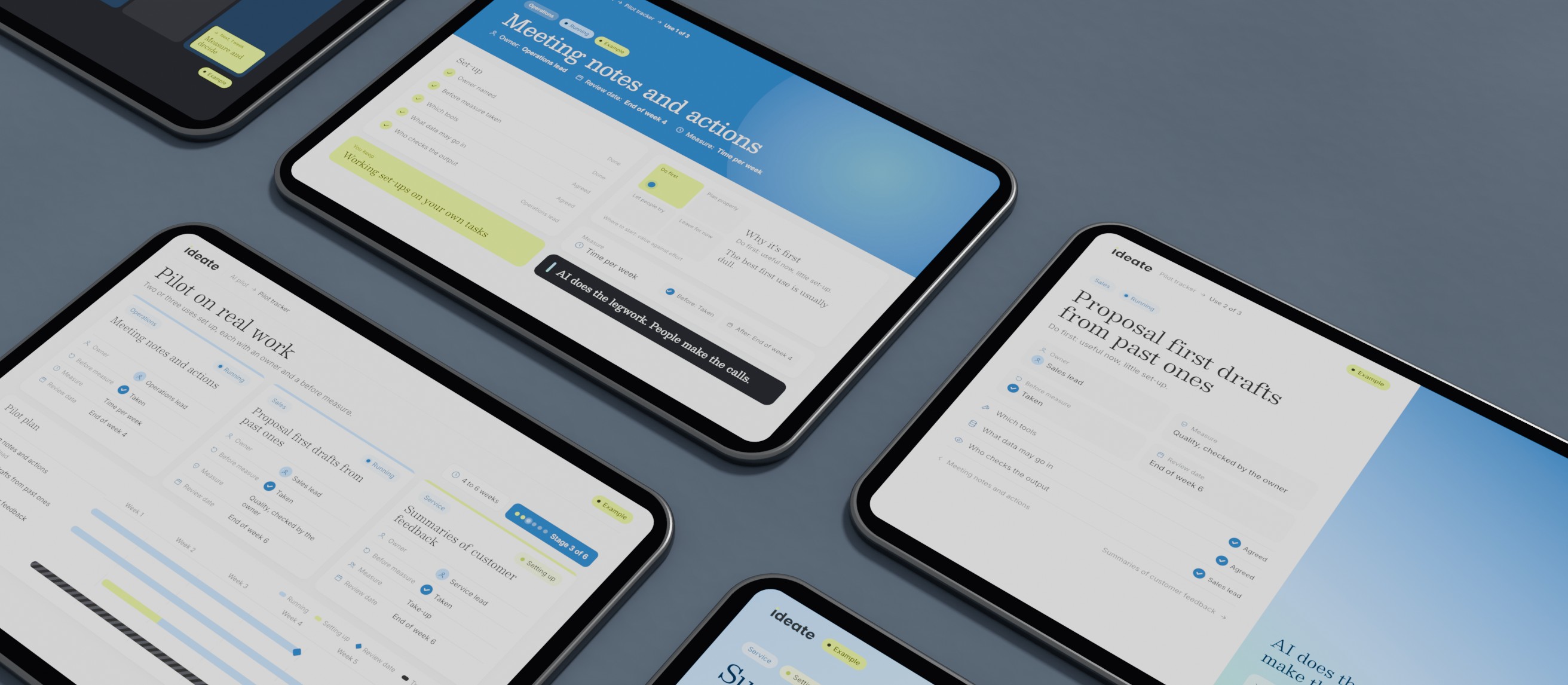
034 to 6 weeksPilot on real work: Two or three uses set up, each with an owner and a before measure. You keep: Working set-ups on your own tasks.
04Alongside the pilotTrain by role: Short sessions on each team’s own tasks. You keep: People who use it without being asked.
051 weekMeasure and decide: Time, quality and take-up, set against the before. You keep: Keep, change or stop, for each use.
06Monthly, for 3 monthsMake it a habit: A monthly look at what’s used, what’s working and what’s next. You keep: A rhythm you run yourselves.
Why AI projects stall, and how we avoid it
- 32%of UK businesses use at least one AI technologyDSIT AI adoption survey, published 29 October 2026; 3,503 UK businesses
- 67%of those users are affected by limited AI skills or knowledgeDSIT AI adoption survey, as above
- 10%of AI-using businesses with 10 or more employees use it extensivelyONS, June 2026
Most AI projects stall for ordinary reasons. Nobody owns them, nobody wrote down what good looks like, and people were never shown how AI fits their own work. The model is rarely the problem.
The government’s figures point the same way. DSIT’s AI adoption survey (published 29 October 2026; 3,503 UK businesses, interviewed January to April 2026) found 32% of businesses using at least one AI technology, and limited AI skills or knowledge affecting 67% of those users. Half of users reported higher productivity, and the gains were generally modest. ONS found the same shallow depth: of businesses with 10 or more employees that use AI, only 10% report using it extensively (June 2026).
So the gap isn’t the tools. It’s choosing the right jobs, agreeing how AI is used and building the habit. That’s why every use in our method gets a named owner and a before measure, and nothing grows until a small version has worked.
Where to start: value against effort
Every use we find goes on this grid. Value is time saved or quality gained. Effort is set-up, data, risk and change for people. Start top left; be wary of bottom right.
Value
Do first
Useful now, little set-up.
- Meeting notes and actions (operations)
- Proposal first drafts from past ones (sales)
- Summaries of customer feedback (service)
- One article turned into posts and emails (marketing)
Plan properly
Worth it, but needs data, rules or training.
- Staff answers from your own documents (operations)
- Reply drafts from your help content (service)
- Call preparation from your CRM records (sales)
- Content in your brand voice, at volume (marketing)
Let people try
Low stakes, fine within the rules.
- Rewording an email (any team)
- Spreadsheet formulas (operations)
- Image ideas for social posts (marketing)
- Translating a short note (service)
Leave for now
Costly for little gain.
- A website chatbot nobody asked for (service)
- Automating a twice-yearly task (operations)
- Your own AI model (any team)
- AI lead scoring on thin data (sales)
Effort
What’s in, and what’s out
Included
- The readiness review and a ranked list of uses
- A short AI policy, and the checks that go with it
- Choosing and setting up the tools for your first uses, with your IT provider
- Training by role, on your team’s own tasks
- Before and after measures for every use
- A monthly check for three months after the pilot
Not included
- Building custom software or your own AI model
- IT support, device management or security testing
- Legal advice: we’ll say where you need a lawyer
- Buying licences on your behalf
Building automations and agents is a separate proposal, made after a pilot.
How we use it ourselves
We run Ideate on the same method, every week.
It works because each job has an owner, a rule and a record, which is what most stalled pilots lack. The whole loop is drawn on Ideate AI.
Every week
- Monday, 7am. Figures for the sites we look after are pulled from Google’s own tools.
- A person decides. They tick the week’s plan.
- More than 40 checks. Across those sites, each with a plain verdict.
- Small fixes. Logged, with how to undo them.
- A second opinion. Another AI lab reviews our code and client work before it goes out.
Who does it

Simon Baghomian
Simon leads the review, the rules and the set-up. He has learnt the tools hands-on (ChatGPT, Claude, Copilot and Codex, and agents that pass work to sub-agents) and onboards others to use them. Each Monday he signs off Ideate’s own weekly plan.

Hayley Simpson
Hayley leads content and training: how AI fits your writing, research and brand voice, and, with Simon, the sessions that get each team using it. She writes Ideate’s own content, and is putting together AI courses of her own.
How to choose an AI consultant
Five checks you can put to anyone, us included. A good AI consultant will be glad you asked.
Five yeses is worth a meeting. A no on starting with your work, or on commission, is the one to worry about: advice that starts with a product tends to end with one. Put all five to us in the Intro.
Worth knowing
A policy isn’t governance
A document nobody reads changes nothing. Rules that work are short, written for your tools, and checked.
The best first use is usually dull
Notes, drafts, summaries. Small wins build the habit that bigger projects need.
Banning AI doesn’t stop it
It moves it onto personal phones and free accounts, where you can’t see it. Give people a safe way instead.
Don’t automate a muddle
AI makes a messy process faster at being messy. Fix the steps, then add AI.
Questions people ask
What does an AI consultant actually do?
An AI consultant looks at how your organisation works, finds the jobs where AI genuinely helps, and gets them working: rules, tools, training and measures. A good one talks more about your work than about AI, and leaves you able to carry on alone.
What’s the difference between AI strategy, implementation and transformation?
Strategy decides which uses are worth doing, and in what order. Implementation puts them to work: rules, set-up, training, measures. Transformation is when the whole organisation changes; in a small or mid-sized one, that’s usually several small implementations done well.
How long does AI consultancy take?
The review takes about three weeks. A first pilot, with training alongside, runs four to six weeks after that, then a monthly check for three months. So the aim is AI in weekly use within about a quarter of starting.
How much does AI consultancy cost?
It depends on how many teams and uses are involved, and whether you want set-up and training as well as advice. We’ll quote once we understand the brief. The first conversation, the Intro, is free.
Do we need to be ready for AI before we start?
No. Working out what’s ready, and what isn’t, is the first stage. Plenty of good first uses need nothing more than the documents and tools you already have.
Will you push us to buy software?
No. We start from your work, and often the answer is a tool you already pay for, set up properly. We take no commission from any vendor. Where something new is worth buying, we’ll say why, and what it replaces.
What will we have at the end?
A ranked list of uses, a short AI policy, tools set up and a team trained on its own tasks. Plus before and after figures for each use, the honest way to show a return on AI, and a monthly rhythm you run yourselves.
What happens to our data?
Before anyone starts, we agree what may go into which tools. Tools are set up in your own accounts, so your data stays under your control. Where personal data is involved, UK GDPR applies; we’ll point you to the ICO’s guidance, and say where you need a lawyer.
Do you build systems or automations?
We advise, train and set up the tools for your first uses. Building automations or agents is a separate proposal, made only once a pilot shows a task is worth it.
What happens after?
You can stop once the habit is in place, or keep us on for a monthly check, a fractional AI lead in effect, until someone in-house takes it over. Either way, the plan and the rules are yours.
Talk to us about AI
Tell us what you’d like AI to do for your organisation. We’ll reply within a working day to book a free Intro.