

AI SEO that gets you found in AI answers
When someone asks Google or ChatGPT who to use, the answer names a few firms and cites a handful of pages. We help you earn a place in it, measure it from Google’s own figures, and promise nothing nobody controls.
What is AI SEO?
AI SEO is the work of making a business easy for AI answers to find, read, trust and cite, in Google’s AI Overviews and AI Mode and in assistants such as ChatGPT. GEO (generative engine optimisation) and AEO (answer engine optimisation) are other names for the same work, and all of it rests on ordinary SEO.
Search, then and now
Search used to hand you a list and leave the reading to you. Now it often does the reading first.
Then: a list of links
- You type a few words
- Ten links and some ads
- You open three or four
- You compare, then decide
- Ranking meant being clicked
Now: an answer first
- You ask a whole question
- AI runs several searches for you
- The answer names a few firms
- A handful of pages are cited
- Being named comes before the click
How an AI answer is put together
Google’s AI answers cite pages from its own search index. Google says AI Overviews and AI Mode may use what it calls query fan-out: they split a question into smaller ones, search each, then write one answer with links to the pages that support it. That’s how a page gets cited for a question it never names: it answered one part clearly.
To be eligible, Google says, a page must be indexed and allowed to show a snippet. No special markup, schema or AI text file is needed. The practice it lists is ordinary SEO: let crawlers in, at your host as well as in robots.txt; link your pages together; keep the important words as text; make structured data match the page; keep your Business Profile current.
Google is plain about the limits. AI Overviews appear only where its systems judge they help, AI Mode falls back to links when it isn’t confident, and both can get things wrong. Other assistants work their own way: OpenAI says sites that shut out its search crawler won’t be shown in ChatGPT’s search answers.
Three signs AI answers are costing you
- 01
Impressions hold, clicks fall
Search Console shows you appearing as often as ever, but fewer people click. On question searches, the answer may be given above you.
- 02
You’re not on the shortlist
Ask an assistant who it would recommend for what you do, where you do it. Your competitors are named. You aren’t.
- 03
What’s said about you is wrong
The answer gives an old name, a service you’ve dropped or the wrong area, or treats a directory or a rival’s article as the source on you.
What’s included
Six parts, in order, each producing something you can see. AI does the legwork, reading and checking. People make the calls.
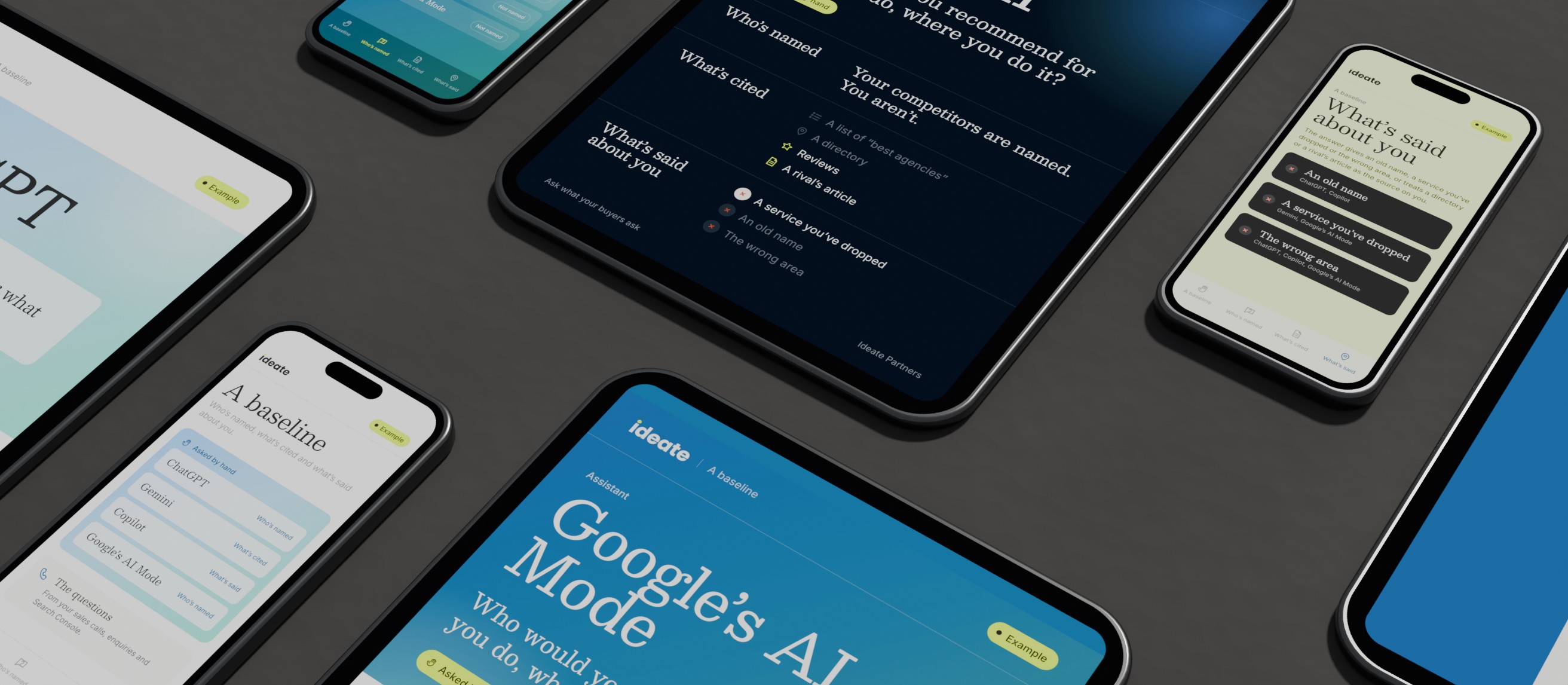

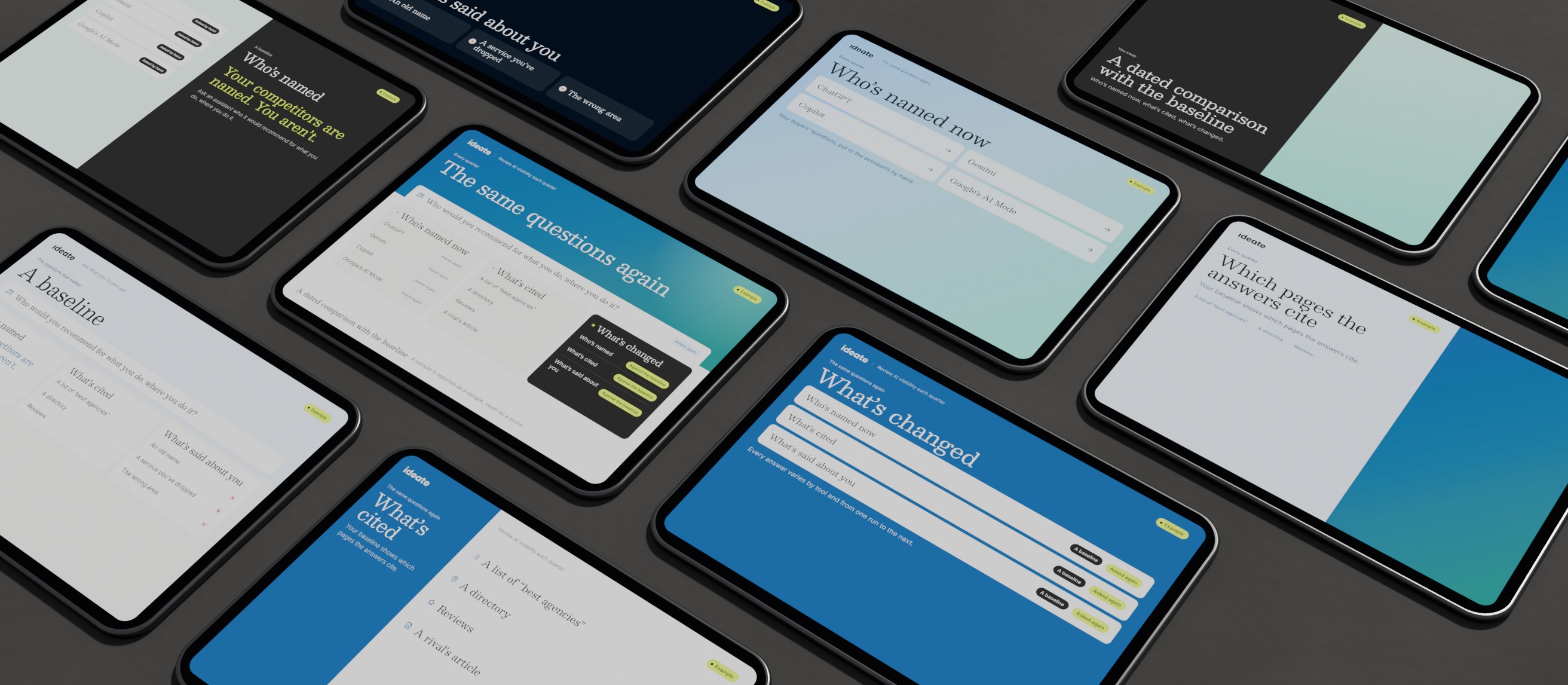
01About two weeksAsk what your buyers ask: We agree the searches and questions that matter, from your sales calls, enquiries and Search Console. Then we put them to ChatGPT, Gemini, Copilot and Google’s AI Mode by hand, noting who’s named and what’s cited. You keep: A baseline: who’s named, what’s cited and what’s said about you.
02The first monthFix what stops you being read: Crawler access, at your host and in robots.txt; pages Google hasn’t indexed; words locked in images; structured data that claims more than the page; your Business Profile. You keep: A short fix list. On sites we look after, small fixes are made and logged with how to undo them.
03A few pages a monthWrite answers worth citing: One page per real question: the short answer first, then the reasoning, examples and sourced figures, in your voice. You keep: Pages that answer what your buyers actually ask.
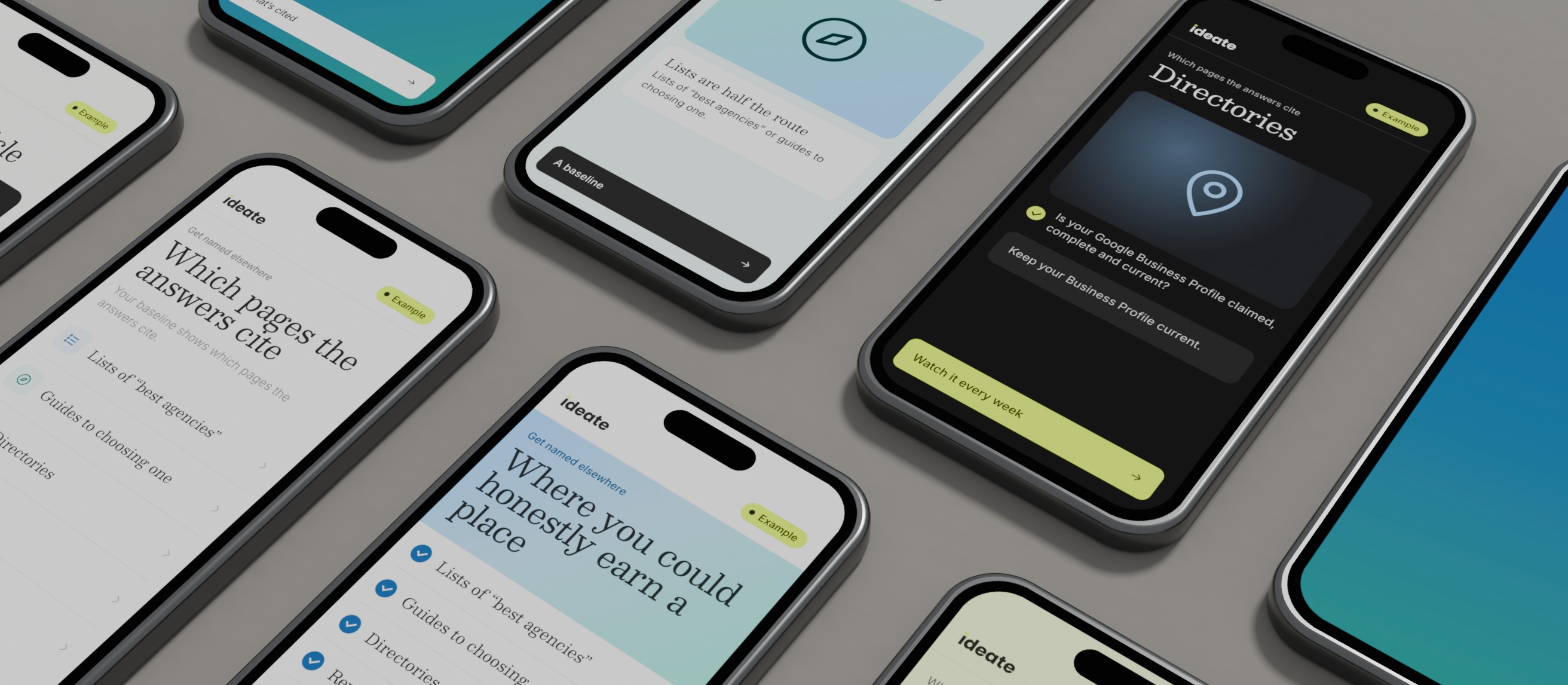
04Alongside the writingGet named elsewhere: Your baseline shows which pages the answers cite. Where they’re lists, directories or reviews, we work out where you could honestly earn a place. You keep: A short list of the places worth being named in.
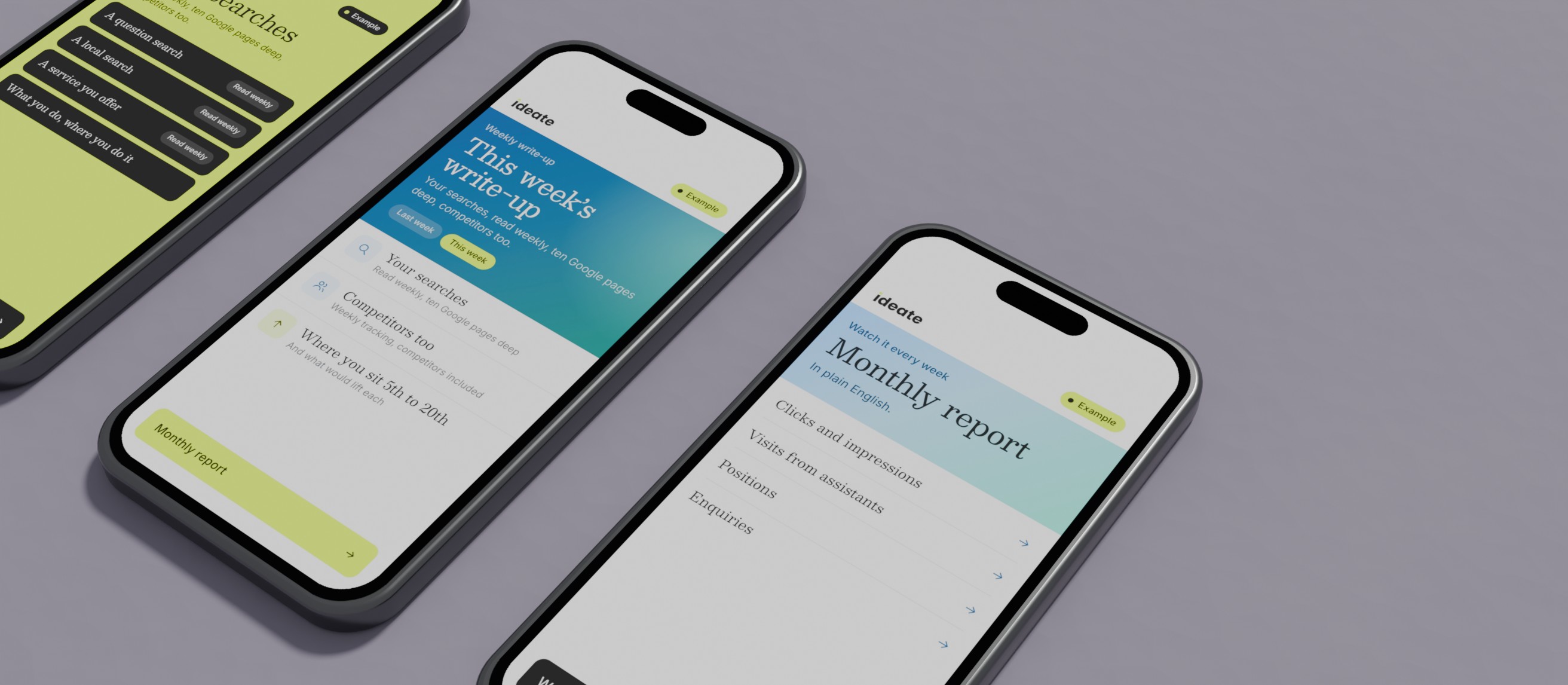
05Every week, from the firstWatch it every week: Your searches are read weekly, ten Google pages deep, competitors too. AI picks out the ones where you sit 5th to 20th, and says what would lift each. You keep: Weekly write-ups and a monthly report in plain English.
06Every quarterReview AI visibility each quarter: The same questions again: who’s named now, what’s cited, what’s changed. You keep: A dated comparison with the baseline.
What we’ve seen for ourselves
Dated, sourced and ours.
- 31%
of the visits ChatGPT and Google search sent us came from ChatGPT
Ideate’s Google Analytics for ideate.partners, 5 Aug to 4 Nov 2026
- 100%
of the local searches we checked were answered by Google’s AI Mode
Ideate’s check of local searches for agencies like ours in five towns, Google UK, 5 Nov 2026
- 90%
of those answers listed firms from their Google Business Profiles
The same check, 5 Nov 2026
What each measure can and can’t see
No single tool sees it all, so each number we report says where it came from and what it misses.
| Where it comes from | What it can’t see | |
|---|---|---|
| Clicks and impressions | Google Search Console, which counts AI Overviews and AI Mode inside its ordinary web figures | Which of those came through an AI answer |
| Visits from assistants | Google Analytics, for visits arriving from ChatGPT, Perplexity, Copilot and others | Answers that named you and sent nobody |
| Positions | Weekly tracking, ten Google pages deep, competitors included | Anything inside ChatGPT or Gemini |
| Being named | Your buyers’ questions, put to the assistants by hand | Every answer: they vary by tool and from one run to the next |
| Enquiries | Your forms and calls in Analytics, plus “how did you hear about us?” | People who don’t say |
Paid “AI visibility” trackers exist. We’d test by hand first, and suggest one only if it would show something the hand checks can’t.
Checks you can run on your own site
A few minutes each. Yes or no.
A no on crawlers, hosting, indexing or the profile comes first: an answer can’t cite what it can’t read. A no on the first two is usually down to the writing.
Worth knowing
Lists are half the route
For “ai seo agency”, six of the nine results on Google’s first page on 5 November 2026 were lists of “best agencies” or guides to choosing one. Being named in other people’s lists is a route of its own. Earn it by being worth including, not by buying a slot.
Blocking AI crawlers has a cost
An assistant can’t cite a page it can’t read, and blocks get switched on without anyone choosing: a hosting firewall can turn a crawler away by name while your robots.txt says it’s welcome. Test it, then decide on purpose.
Your customers write the brief
AI answers are built around whole questions. The questions worth answering come from sales calls, enquiry emails and interviews, not from a keyword tool. Ask the people who ask.
A mention isn’t a sale
The page people land on has to confirm what the answer told them, in its first few lines. If it doesn’t, they go back and ask again, and the next firm gets the call.
Questions people ask
Can AI do my SEO?
Some of it. AI is good at the legwork: reading data, spotting changes, checking pages. Google’s guidance allows AI-made content that’s accurate and useful, and says generating many pages without adding value can break its spam policy. Deciding what to say, and whether it’s true, stays with people.
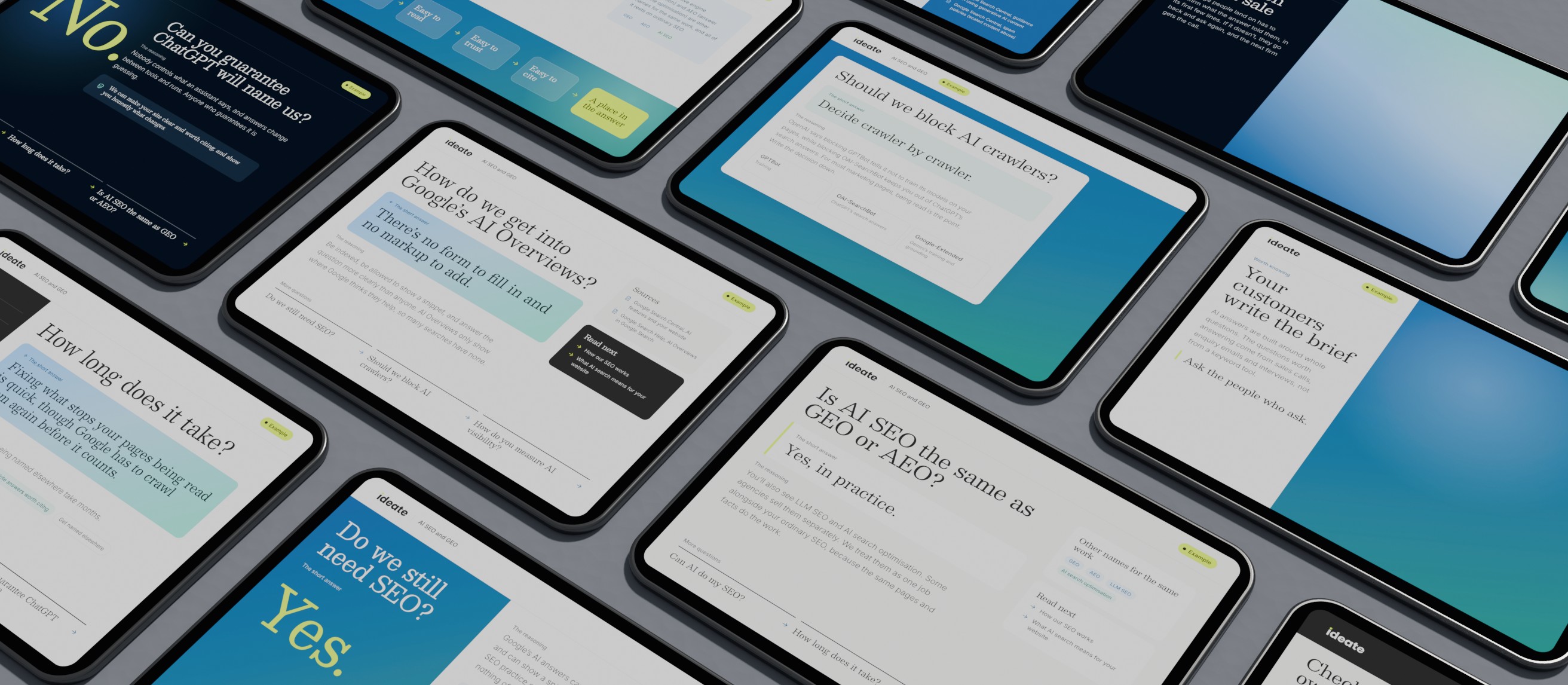
Is AI SEO the same as GEO or AEO?
Yes, in practice, and you’ll also see LLM SEO and AI search optimisation. Some agencies sell them separately. We treat them as one job alongside your ordinary SEO, because the same pages and facts do the work.
Do we still need SEO?
Yes. Google’s AI answers can only cite pages it has indexed and can show a snippet for, and Google says the usual SEO practice still applies. Without it, Google’s AI has nothing of yours to draw on.
How do we get into Google’s AI Overviews?
There’s no form to fill in and no markup to add. Be indexed, be allowed to show a snippet, and answer the question more clearly than anyone. AI Overviews only show where Google thinks they help, so many searches have none: none of the local searches we checked on 5 November 2026 did.
How long does it take?
Fixing what stops your pages being read is quick, though Google has to crawl them again before it counts. Better answers and being named elsewhere take months. We’ll show you a first comparison with your baseline after three months.
What does it cost?
It depends on how many searches matter, how much writing is needed and whether we already look after your site. We’ll quote once we understand the brief, and our website cost guide shows how we think about budgets.
How do you measure AI visibility?
Search Console and Analytics for what Google and the assistants send you, weekly tracking for where you sit, and your buyers’ questions asked by hand for who gets named. A sample is reported as a sample, never as a score.
Can you guarantee ChatGPT will name us?
No. Nobody controls what an assistant says, and answers change between tools and runs. Anyone who guarantees it is guessing. We can make your site clear and worth citing, and show you honestly what changes.
Should we block AI crawlers?
Decide crawler by crawler. OpenAI says blocking GPTBot tells it not to train its models on your pages, while blocking OAI-SearchBot keeps you out of ChatGPT’s search answers. Google-Extended covers Gemini’s training and grounding, and Google says it doesn’t affect Search. For most marketing pages, being read is the point. Write the decision down.
Ask for a free AI visibility check
Tell us what you do, where you do it and what your buyers ask. We’ll put a few of those questions to the AI assistants by hand and show you who they name.